Master European Scientists, Inventors, Medical Breakthroughs, Physics, Chemistry, Biology, Engineering, Space Exploration & Computing
This 50 European Science & Technology Study Guide covers groundbreaking scientists, inventors, medical discoveries, physics, chemistry, biology, engineering, space exploration (ESA), mathematics, computer science, and technological innovations from across Europe. Each question includes four answer choices with the correct answer provided for self-checking.
Comment your score below after tallying your correct answers. Perfect for STEM review, science history units, or classroom competitions. Share this quiz with classmates to celebrate Europe’s enduring legacy of discovery and innovation.
Top 50 European Science & Technology Study Guide
#1. Which English mathematician invented the first mechanical computer (Analytical Engine)?
#2. Which Italian inventor built the first modern internal combustion engine?
#3. Which Swedish chemist invented dynamite and established the Nobel Prizes?
#4. Which British scientist discovered penicillin?
#5. Which British mathematician is known as the “father of modern computing” for his work on the Turing Machine?
#6. Which German physicist first demonstrated electromagnetic waves?
#7. Which German-born physicist was awarded the Nobel Prize for the photoelectric effect explanation?
#8. Which German physicist discovered the quantum theory (Planck’s constant)?
#9. Which German inventor created the first automobile (Benz Patent-Motorwagen)?
#10. Which British naturalist developed the theory of evolution by natural selection?
#11. Which Danish physicist won the Nobel Prize for his work on atomic structure?
#12. Which Dutch physicist discovered superconductivity in mercury at very low temperatures?
#13. Which German rocket scientist developed the V-2 rocket and later worked for NASA?
#14. Which British physician developed the smallpox vaccine?
#15. Which Austrian scientist known for the concept of “self-organization” and dissipative structures won a Nobel Prize in Chemistry in 1977?
#16. Which Swedish botanist developed the modern system of naming organisms (binomial nomenclature)?
#17. Which German physician discovered the bacteria that cause tuberculosis and cholera?
#18. Which Austrian physicist won the Nobel Prize for the discovery of nuclear fission?
#19. Which German scientist discovered the first antibiotic (Prontosil) leading to sulfa drugs?
#20. Which British physicist discovered the neutron?
#21. Which British engineer developed the World Wide Web (WWW) in 1989?
#22. Which English inventor created the first practical steam engine?
#23. Which British scientist is known as the “Father of Computer Science”?
#24. Which French biologist developed pasteurization and vaccines for rabies?
#25. Which Polish-French scientist discovered radium and polonium?
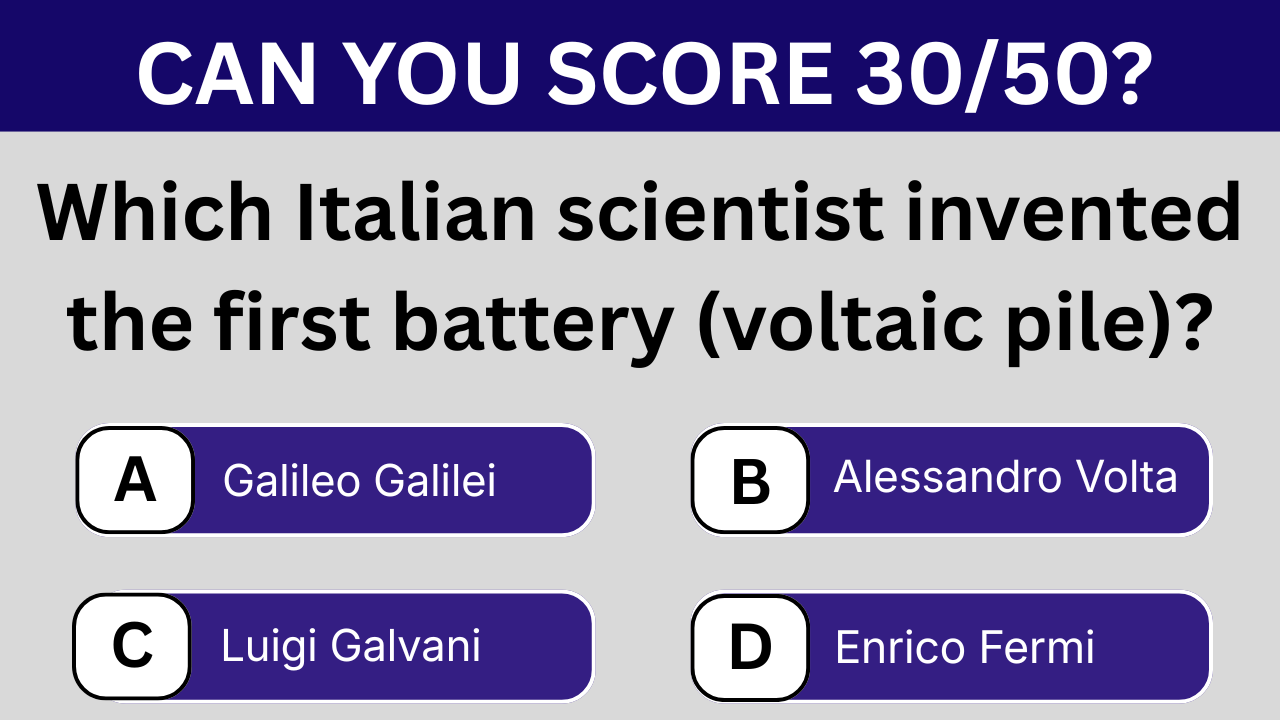
#26. Which Italian scientist invented the first battery (voltaic pile)?
#27. Which Swiss astronomer discovered the first exoplanet (51 Pegasi b) in 1995?
#28. Which Russian chemist is famous for the periodic table of elements?
#29. Which Austrian physicist developed Schrödinger’s cat thought experiment?
#30. Which Italian astronomer was the first to use a telescope for astronomical observations?
#31. Which German-born physicist developed the uncertainty principle?
#32. Which Scottish engineer improved the steam engine and invented the horsepower unit?
#33. Which British physicist discovered the electron?
#34. Which Scottish inventor is known for the telephone?
#35. Which British scientist discovered hydrogen?
#36. Which Italian physicist discovered nuclear fission after bombarding uranium with neutrons?
#37. Which Spanish neuroscientist known as the “father of modern neuroscience” won the Nobel Prize in 1906?
#38. Which Finnish company invented the first cellular phone (handheld mobile phone) in 1973?
#39. Which British physicist discovered the structure of DNA alongside Francis Crick?
#40. Which French chemist is known as the “Father of Modern Chemistry”?
#41. Which French physicist discovered radioactivity?
#42. Which Hungarian-American mathematician is known for the concept of the “minimum max” theorem and game theory?
#43. Which Italian physicist invented the radio?
#44. Which German physicist developed the theory of general relativity?
#45. Which French mathematician is known for his work on probability and the Pascal’s law of pressure?
#46. Which French mathematician and physicist invented the first mechanical calculator (Pascaline)?
#47. Which British engineer invented the first jet engine?
#48. Which German physicist discovered X-rays?
#49. Which German engineer developed the first programmable computer?
#50. Which Dutch scientist invented the microscope and discovered bacteria?
More Quizzes-