Grade 6 USA Geography Questions with Answers for Middle School Students
This 6th Grade US Geography Quiz is designed for middle school students in the USA. It includes 20 carefully written questions with teacher-style explanations to help students understand U.S. regions, landforms, climate, and maps.
Get daily quizzes, practice tests, and free learning updates.
Follow on FacebookAmerican Geography Quiz for Grade 6 | US Geography Quiz Test Free
Results
Great work. Scoring 70% or higher shows a strong understanding of U.S. geography. Keep practicing to improve your map reading and regional knowledge.
More Latest Quizzes – Click Here.
Do not feel discouraged. Review the explanations carefully and try again. With regular practice, your geography skills will continue to improve.
More Latest Quizzes – Click Here.


#1. Which map is best for showing state boundaries?
Explanation: Political maps focus on borders, states, and cities rather than natural features.
#2. Which U.S. region is known for dense forests and heavy rainfall?
Explanation: This region receives frequent rain, supporting thick forests and rich plant life.
#3. Which U.S. river flows into the Gulf of Mexico?
Explanation: The Mississippi River carries water from much of the country into the Gulf of Mexico.
#4. Why are mountains important to geography?
Explanation: Mountains influence weather patterns, rainfall, and how people travel and settle.
#5. Which U.S. region is known as the Great Plains?
Explanation: The Great Plains stretch across the central part of the country and are known for flat land and farming.
#6. Which region of the U.S. experiences frequent hurricanes?
Explanation: Warm ocean waters near the Southeast help fuel hurricanes during storm season.
#7. Which U.S. region is best known for corn and soybean farming?
Explanation: The Midwest has fertile soil and is often called America’s agricultural heartland.
#8. Which U.S. river flows westward into the Pacific Ocean?
Explanation: The Columbia River flows through the Northwest and empties into the Pacific Ocean.
#9. Which U.S. state has access to the Arctic Ocean?
Explanation: Alaska is the only U.S. state that borders the Arctic Ocean.
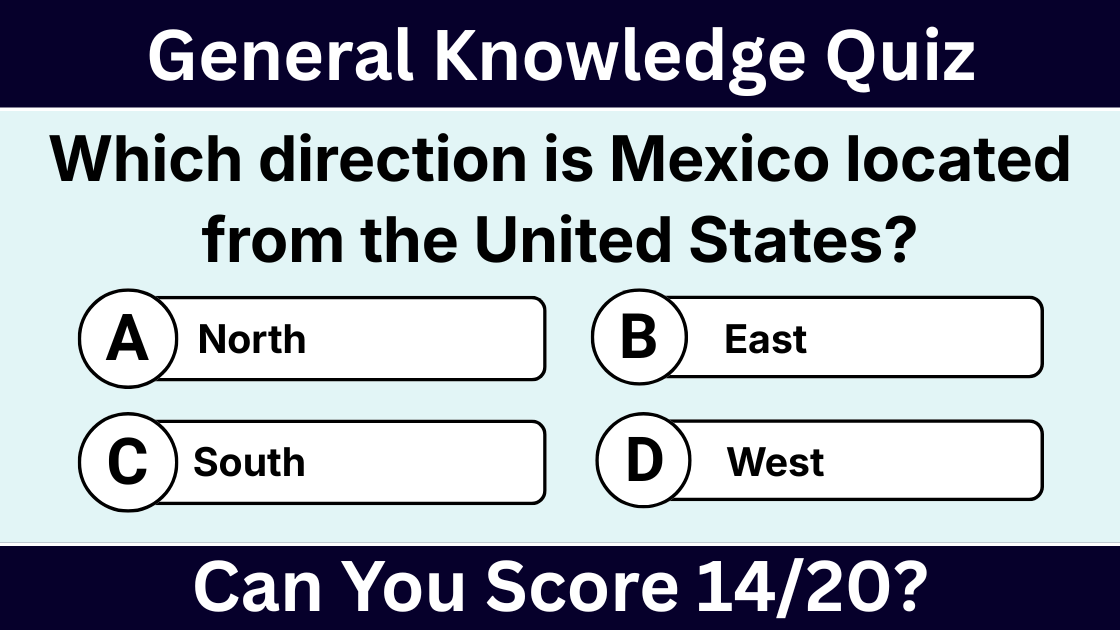
#10. Which direction is Mexico located from the United States?
Explanation: Mexico lies directly south of the United States and shares a long land border.
#11. Which mountain range forms a natural barrier between the coastal and interior West?
Explanation: The Rocky Mountains run north to south and separate the western interior from coastal areas.
#12. Which U.S. state is made up of a chain of islands?
Explanation: Hawaii is an island state located in the Pacific Ocean and formed by volcanic activity.
#13. Which U.S. state has the most volcanoes?
Explanation: Alaska has many volcanoes due to its location along tectonic plate boundaries.
#14. Which time zone is the earliest in the United States?
Explanation: The Eastern Time Zone is the first to experience a new day in the U.S.
#15. Which U.S. body of water separates Florida from Cuba?
Explanation: The Gulf of Mexico lies south of Florida and separates it from nearby countries.
#16. Which state borders both Canada and Mexico?
Explanation: Texas is unique because it shares a border with Mexico to the south and has water borders near Canada through the Great Lakes region.
#17. Which U.S. state touches both the Atlantic Ocean and the Gulf of Mexico?
Explanation: Florida is bordered by the Atlantic Ocean on one side and the Gulf of Mexico on the other.
#18. Which U.S. landform is created by erosion from rivers over time?
Explanation: Canyons form when rivers slowly wear away rock, creating deep valleys over millions of years.
#19. Which Great Lake is located entirely within the United States?
Explanation: Lake Michigan is the only Great Lake that lies completely within U.S. borders.
#20. Which climate is most common in the southeastern United States?
Explanation: The Southeast has hot summers, mild winters, and plenty of rainfall throughout the year.