Are You Smarter Than 9th Grader Biology Quiz
Are you smarter than 9th grader biology quiz? 20 HS biology quiz: helicase DNA replication, Hardy-Weinberg 2pq heterozygotes, glycolysis 2 pyruvate, peptide bonds, incomplete dominance, 9:3:3:1 dihybrid ratios!
Smarter Than 9th Grader Biology Quiz for Grade 9 Students
9th grade biology quiz challenge: helicase unwinds DNA, S-phase replication, tRNA amino acids, Hardy-Weinberg 2pq, glycolysis pyruvate, peptide bonds protein synthesis, 9:3:3:1 dihybrid. Smarter than high schooler?
Get daily quizzes, practice tests, and free learning updates.
Join WhatsApp Channel Follow on Facebook20 challenging Grade 9 biology questions for high school students. HS-LS1/HS-LS3 NGSS aligned. Test if you’re smarter than 9th grader! 70% (14/20) to PASS!
Results
You’re SMARTER than a 9th grader! 🎉
Mastered high school biology: DNA replication (helicase/S-phase), protein synthesis (tRNA/ribosomes), Hardy-Weinberg equilibrium, and metabolic pathways.
Elite HS-LS1 preparation for AP Biology success!
More Quizzes – Click Here.
Close! 9th grade biology challenges even adults.
Review DNA structure, Punnett ratios, cellular respiration pathways, and Mendelian genetics through diagrams.
Next attempt: high school biology mastery awaits!
More Quizzes – Click Here.


#1. In which phase of the cell cycle does DNA replication occur?
Explanation: Synthesis (S) phase: DNA doubles from 2C → 4C. Chromatin → chromosomes. Checkpoints ensure accurate replication before mitosis.
#2. What enzyme unwinds DNA double helix during replication?
Explanation: Helicase breaks hydrogen bonds (10-12 bp/sec). Replication fork forms. Single-strand binding proteins stabilize strands.
#3. What is the end product of glycolysis (10 glucose steps)?
Explanation: Anaerobic: cytoplasm. Glucose → 2 pyruvate + 2 ATP (net) + 2 NADH. Pyruvate → Krebs cycle (aerobic) or fermentation.
#4. In pea plants, what dihybrid cross ratio (F2)?
Explanation: Mendel: independent assortment. 9 dominant both, 3 dom1/rec2, 3 rec1/dom2, 1 recessive both traits.
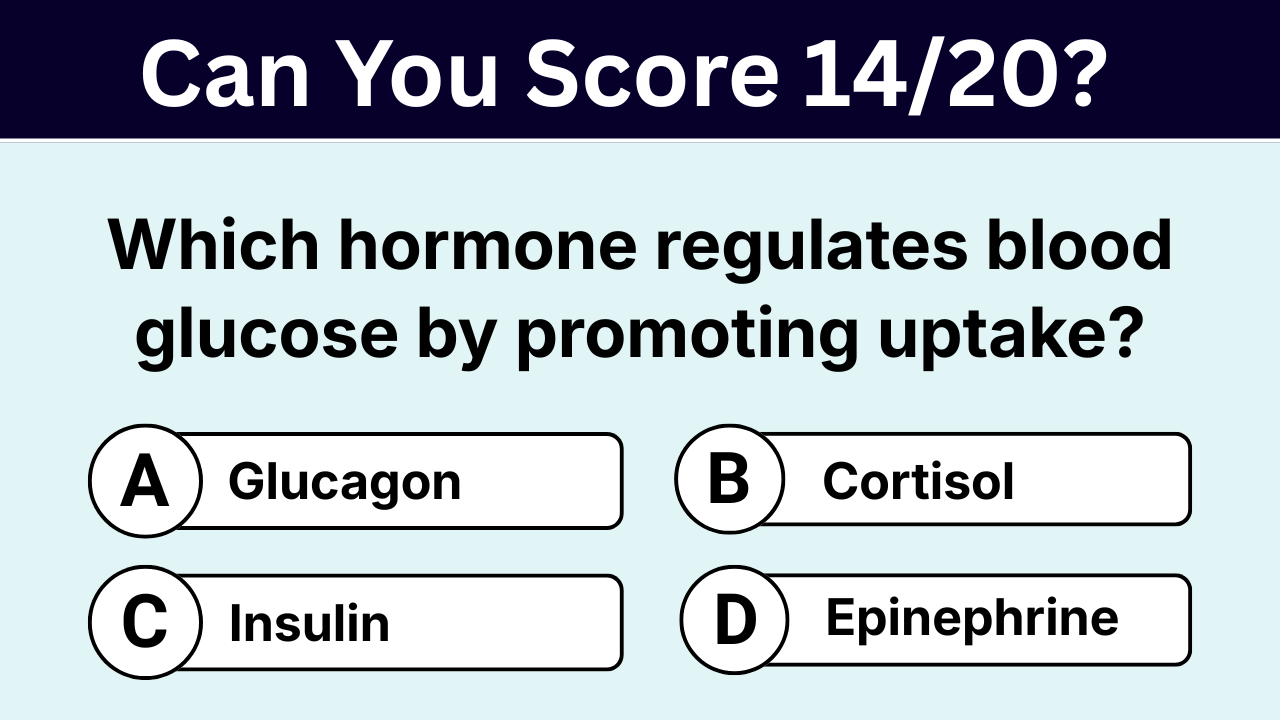
#5. Which hormone regulates blood glucose by promoting uptake?
Explanation: Beta cells (pancreas). Lowers blood sugar → glycogen synthesis. Type 1 diabetes: autoimmune destruction.
#6. What carries genetic info from nucleus to ribosome?
Explanation: Messenger RNA: transcription (5′ cap, poly-A tail). Splicing removes introns. Codons read 5′→3′.
#7. What Mendelian exception shows blended traits?
Explanation: RR red, WW white → RW pink snapdragons. Neither allele completely dominant.
#8. In humans, which chromosome carries most genes?
Explanation: Chromosome 1: longest (249 Mbp), ~8% genome. Y chromosome: smallest (~60 Mbp), fewest genes.
#9. Which disorder from single base mutation (sickle cell)?
Explanation: GAG → GTG (glutamic acid → valine) in hemoglobin β-globin gene. Heterozygote advantage (malaria resistance).
#10. Which base pairs with adenine in DNA?
Explanation: A-T (2 H-bonds), G-C (3 H-bonds). DNA vs RNA: thymine vs uracil. Chargaff’s rules: A=T, G=C.
#11. What is the powerhouse of the cell (site of ATP production)?
Explanation: Mitochondria perform cellular respiration: C₆H₁₂O₆ + 6O₂ → 6CO₂ + 6H₂O + ~36 ATP. Double membrane; cristae increase surface area. Own mtDNA (16,569 bp).
#12. What type of bond links amino acids in polypeptide chain?
Explanation: Dehydration synthesis: carboxyl (COOH) + amino (NH₂) → peptide + H₂O. Peptide bonds form primary protein structure.
#13. Which organelle is site of photosynthesis in plant cells?
Explanation: Thylakoids (light reactions), stroma (Calvin cycle). Chlorophyll absorbs 680/700nm light. 6CO₂ + 6H₂O → C₆H₁₂O₆ + 6O₂.
#14. What process moves substances against concentration gradient?
Explanation: Requires ATP/carrier proteins (Na⁺/K⁺ pump: 3Na⁺ out, 2K⁺ in). Sodium-potassium pump maintains resting potential (-70mV).
#15. According to Hardy-Weinberg, what genotype frequency for heterozygotes?
Explanation: p + q = 1; p² + 2pq + q² = 1. Heterozygotes = 2pq. Equilibrium: no evolution (random mating, infinite population, no selection/migration/mutation).
#16. How many ATP from complete glucose oxidation?
Explanation: Glycolysis (2) + Krebs (2) + ETC (26-34) = 30-36 ATP/glucose. Theoretical 38; proton leak reduces efficiency.
#17. What protein reads mRNA and synthesizes polypeptides?
Explanation: 80S eukaryote ribosomes (40S + 60S subunits). rRNA + proteins. A/P/E sites for tRNA binding.
#18. Which phase of meiosis produces genetic recombination?
Explanation: Homologous chromosomes exchange segments (chiasmata). Increases genetic diversity beyond independent assortment.
#19. What is the function of tRNA during protein synthesis?
Explanation: Transfer RNA: anticodon matches mRNA codon, aminoacyl-tRNA synthetase attaches specific amino acid. 61 codons → 20 amino acids.
#20. What structure maintains cell shape and enables movement?
Explanation: Tubulin proteins form 25nm hollow tubes. Cilia/flagella (9+2 arrangement). Mitotic spindle separates chromosomes.
More – Grade 8 Science Quizzes