12th Grade Shakespeare Quiz | AP English 20 Questions with Answers
AP Lit Grade 12 Shakespeare Literature Quiz! 20 questions: Hamlet “To be or not to be,” Macbeth witches prophecy, Romeo Tybalt duel, iambic pentameter, Shakespearean sonnet ABAB CDCD EFEF GG, King Lear daughters.
Shakespeare Literature Quiz For Grade 12
Grade 12 AP English Shakespeare quiz: Hamlet soliloquy, Jaques “All world’s stage,” ABAB CDCD EFEF GG sonnets, Macbeth witches, Tybalt Romeo duel, Othello green-eyed monster, Merchant pound flesh.
Get daily quizzes, practice tests, and free learning updates.
Follow on Facebook20 AP English Literature Shakespeare questions for Grade 12. Focus: tragedies, comedies, sonnets. 70% (14/20) to PASS! Analyze quotes, characters, themes.
Results
AP English Shakespeare mastery achieved! 🎭
You’ve conquered Grade 12 Bard challenges: Hamlet soliloquies, iambic pentameter mastery, sonnet structures (ABAB CDCD EFEF GG), and complex character analysis.
Elite preparation for AP Literature exam 5!
More Quizzes – Click Here.
Strong Shakespeare foundation building!
12th grade AP Lit success requires quote identification, dramatic structure analysis, and Elizabethan context mastery through close reading.
Review literary devices/explanations—you’ll ace Bard next time!
More Quizzes – Click Here.


#1. Macbeth’s wife urges: “Give suck” speech about _____?
Explanation: Act 1, Scene 7. “I have given suck… dashed brains out.” Suppresses maternal instinct for power.
#2. Sonnet 18 begins: “Shall I compare thee to a _____ day?”
Explanation: Fair youth sequence. “Thou art more lovely and more temperate.” Immortality through poetry.
#3. What device: Juliet = sun, Romeo = pilgrim?
Explanation: Extended metaphors/conceits. Balcony scene: celestial, religious imagery.
#4. Which character: “Brevity is soul of wit” (Polonius)?
Explanation: Act 2, Scene 2 irony (verbose Polonius). Hamlet mocks pretentious counselor.
#5. Who betrays Caesar: “Et tu, Brute?”
Explanation: Act 3, Scene 1 assassination. Noble Brutus joins conspiracy (honor vs loyalty).
#6. Who is tragic hero in Othello (manipulated by Iago)?
Explanation: Moorish general; jealousy destroys. “O, beware, my lord, of jealousy; It is the green-eyed monster.”
#7. Which play features three witches prophesying to Macbeth?
Explanation: “Scottish play” (superstition). Act 1: “Fair is foul, and foul is fair.” Prophecies: Thane Cawdor, king, no man born of woman, Birnam Wood.
#8. In Romeo and Juliet, who challenges Romeo to duel?
Explanation: Act 3, Scene 1. Tybalt (Capulet) kills Mercutio; Romeo avenges. Escalates feud to tragedy.
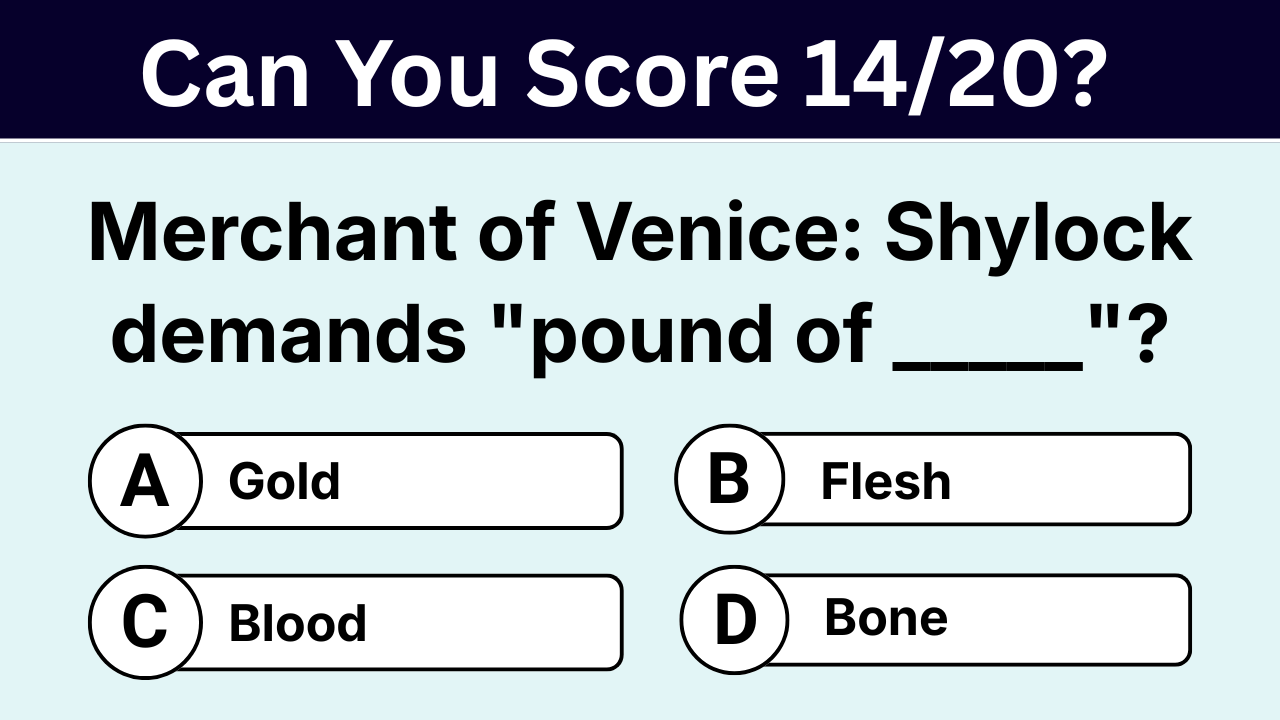
#9. Merchant of Venice: Shylock demands “pound of _____”?
Explanation: Antonio bond for Bassanio’s loan. “Hath not a Jew eyes?” famous speech.
#10. Which comedy features lovers enchanted in Athenian woods?
Explanation: Oberon/Puck mischief; Theseus/Hippolyta wedding. Bottom’s ass-head transformation.
#11. What structure: 5 acts, rising/falling action?
Explanation: Freytag pyramid: exposition, rising action, climax (Act 3), falling, catastrophe/denouement.
#12. Sonnet form: 14 lines, volta typically where?
Explanation: Shakespearean: quatrains build problem; sestet (couplet) resolves. Italian: octave/sestet.
#13. Who kills King Duncan in Macbeth?
Explanation: Act 2, Scene 2 dagger hallucination. “Is this a dagger which I see before me?”
#14. Which comedy: twins separated by shipwreck?
Explanation: Viola/Cesario disguise; Orsino/Olivia love triangle. “If music be the food of love, play on.”
#15. What meter dominates Shakespearean verse?
Explanation: Unstressed-stressed: da-DUM ×5. Blank verse (unrhymed). Natural English speech rhythm.
#16. In Tempest, where does play primarily take place?
Explanation: Prospero’s magical island. Late romance; themes forgiveness, colonialism, art/nature.
#17. What is Shakespearean sonnet rhyme scheme (first 12 lines)?
Explanation: English/Shakespearean sonnet: 14 lines iambic pentameter. 3 quatrains + volta (turn) + couplet resolution.
#18. Which Shakespeare play contains “To be, or not to be” soliloquy?
Explanation: Hamlet Act 3, Scene 1. Famous existential contemplation on suicide/life’s burdens. “Whether ’tis nobler in the mind to suffer / The slings and arrows of outrageous fortune.”
#19. Who says “All the world’s a stage” in As You Like It?
Explanation: Act 2, Scene 7. “Seven ages of man” speech: infant, schoolboy, lover, soldier, justice, pantaloon, second childishness. Metaphor for life stages.
#20. In which tragedy does Lear divide kingdom between daughters?
Explanation: Goneril/Regan flatter; Cordelia truthful (disinherited). “Nothing will come of nothing.”
More – Grade Wise Geography Quiz Test