Grade 9 Chemistry Elements Practice Questions for High School Students
9th Grade Chemistry Elements Quiz! 20 high school questions: H hydrogen #1, C carbon #6, O oxygen #8, Na sodium #11, Fe iron ferrum, Au gold aurum, K potassium, groups 17 halogens 18 noble gases.
9th Grade Chemistry Elements Quiz Questions and Answers
High school Grade 9 chemistry elements quiz: Hydrogen H #1 lightest, Carbon C #6 organic basis, Oxygen O #8 respiration, Sodium Na alkali metal, Iron Fe hemoglobin, Gold Au noble metal corrosion-proof.
Get daily quizzes, practice tests, and free learning updates.
Follow on Facebook20 Grade 9 chemistry elements questions for US high school. Periodic table mastery test. 70% (14/20) to PASS!
Results
9th Grade Chemistry ELEMENTS MASTER! 🧪
You’ve conquered the periodic table: H (hydrogen #1), C (carbon #6), Fe (iron ferrum), Au (gold aurum), Groups 17/18 properties, atomic structure perfection.
High school chemistry foundation SOLID—AP Chem ready!
More Quizzes – Click Here.
Strong chemistry foundation building!
Grade 9 elements mastery needs daily periodic table review + atomic number flashcards + group properties practice.
Study detailed explanations—you’ll ace chemistry next lab period!
More Quizzes – Click Here.


#1. Columns = chemical properties same?
Explanation: 18 vertical groups share valence electrons. Group 1 reactive metals. Group 17 reactive nonmetals. Group 18 stable gases.
#2. Aluminum symbol?
Explanation: Aluminum lightweight metal. Aircraft, beverage cans. Self-protecting Al2O3 oxide layer.
#3. Atomic number = # of?
Explanation: Atomic number = protons defines element. H (1p+), C (6p+), Au (79p+). Neutral atom: electrons = protons.
#4. Atomic number Magnesium?
Explanation: Magnesium, group 2 alkaline earth. Mg2+ in chlorophyll photosynthesis. Dietary: nuts, spinach, whole grains.
#5. Gold symbol?
Explanation: Au (Latin “aurum”). Gold noble metal—doesn’t tarnish. Most malleable (gold leaf 0.1 micrometer). Electronics conductor.
#6. Silicon atomic number?
Explanation: Silicon metalloid, semiconductors. 27.7% crust (sand SiO2). Silicon Valley computer chips.
#7. Which group contains alkali metals (Li, Na, K)?
Explanation: Group 1 (leftmost column): Lithium, Sodium, Potassium. Most reactive metals—1 valence electron easily lost (M → M⁺ + e⁻). Stored in oil, explode in water.
#8. Calcium symbol?
Explanation: Calcium group 2. Bones/teeth: Ca10(PO4)6(OH)2 hydroxyapatite. Milk ~1200mg/L.
#9. Which element: atomic mass ~79, symbol Ag?
Explanation: Silver (Ag 47) highest electrical/thermal conductivity. Atomic mass 107.87 amu. Sterling 92.5% Ag + 7.5% Cu.
#10. Periodic table rows called?
Explanation: 7 horizontal periods. Atomic number increases left→right. Period 1: H-He. Period 2: Li-Ne.
#11. Noble gases group number?
Explanation: Group 18 (rightmost): He, Ne, Ar, Kr, Xe, Rn. Octet rule complete valence shells. Chemically inert.
#12. Symbol Fe represents?
Explanation: Fe (Latin “ferrum”). Iron transition metal. Magnetic, hemoglobin Fe2+ carries oxygen. Rust: 4Fe + 3O2 → 2Fe2O3.
#13. Atomic mass mostly from?
Explanation: Nucleus 99.9% atom mass. Proton ≈ neutron ≈ 1 amu. 12C: 6p + 6n = 12 amu standard.
#14. Which: atomic 17, Cl?
Explanation: Chlorine halogen (group 17). Green-yellow gas. NaCl salt, bleach (NaOCl), PVC plastic.
#15. Symbol K = ?
Explanation: K (Arabic “qali”). Potassium group 1. Nerve/muscle function. Banana: 422mg medium fruit.
#16. Chemical symbol for Hydrogen?
Explanation: Carbon has 6 protons (period 2, group 14). 6 electrons in 2 shells. Organic chemistry backbone—4 covalent bonds (CH4, C6H12O6).
#17. Which element: Na (atomic 11)?
Explanation: Na = Sodium, group 1 alkali metal. Reacts violently with water: 2Na + 2H2O → 2NaOH + H2↑. Table salt NaCl.
#18. Symbol for Oxygen?
Explanation: Oxygen single atom “O.” Respiration essential: C6H12O6 + 6O2 → 6CO2 + 6H2O. 21% atmosphere, 65% human body mass.
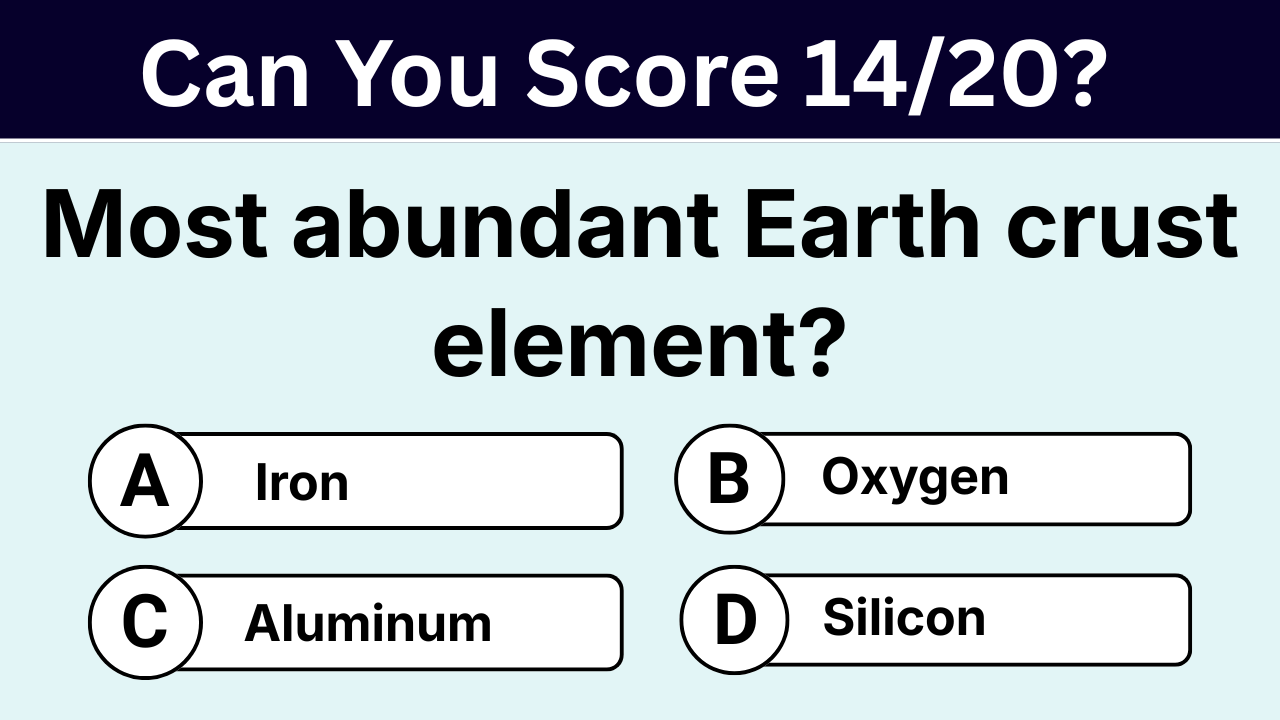
#19. Most abundant Earth crust element?
Explanation: Oxygen 46.6% crust mass. SiO2 sand/quartz, Al2O3 bauxite, Fe2O3 hematite—all oxides.
#20. Helium atomic number?
Explanation: Helium first noble gas (group 18). Big Bang fusion product. Non-flammable (party balloons), MRI cryogenics.
More – Latest Quizzes for Grade 5-12