Grade 10 Biology Ecosystems Quiz Questions and Answers
This 10th grade biology ecosystems quiz is designed by a teacher to help students understand food chains, producers, consumers, decomposers, and energy flow. Includes 20 carefully explained multiple-choice questions ideal for Grade 10 students and exam preparation.
Biology Ecosystems Quiz For Grade 10
This biology ecosystems quiz has been carefully prepared by a teacher to help 10th grade students clearly understand food chains, food webs, producers, consumers, decomposers, and energy flow in ecosystems.
Each question is designed according to Grade 10 biology standards and explained in simple language so students can easily learn the concept instead of just memorizing answers. This worksheet is ideal for classroom practice, homework, self-study, and exam preparation.
Students are encouraged to read each explanation carefully, as understanding how energy moves through an ecosystem is an important foundation topic in biology.
Get daily quizzes, practice tests, and free learning updates.
Follow on Facebook10th Grader Biology Ecosystems Quiz | Food Chains 20 Questions with Answers
Results
Well done! You have passed this quiz and shown a clear understanding of food chains and ecosystems. Keep practicing similar quizzes on Quizmento to improve accuracy and confidence for school exams.
More Latest Quizzes – Click Here.
Do not worry. This quiz is part of learning. Review the explanations carefully and try again. Regular practice on Quizmento will help you master biology concepts step by step.
More Latest Quizzes – Click Here.


#1. What is the main source of energy for most food chains?
Explanation: The Sun is the primary source of energy for nearly all ecosystems. Plants capture sunlight during photosynthesis and convert it into chemical energy, which then flows through the food chain.
#2. Which level of a food chain has the most energy?
Explanation: Producers have the most energy because they receive energy directly from the Sun. As energy moves up the food chain, a large amount is lost as heat, so higher levels have less energy available.
#3. What is an ecosystem?
Explanation: An ecosystem includes all living organisms such as plants, animals, and microorganisms along with non-living components like air, water, sunlight, soil, and temperature. These parts interact with each other and depend on one another to survive. Without both living and non-living components working together, an ecosystem cannot function properly.
#4. Which organism breaks down dead plants and animals?
Explanation: Decomposers such as bacteria and fungi break down dead organisms into simpler substances. This process returns important nutrients back to the soil, which helps plants grow and keeps the ecosystem balanced.
#5. Which organism is considered a top predator?
Explanation: A top predator is an organism that is at the highest level of the food chain and has no natural predators. Lions hunt other animals but are rarely hunted themselves.
#6. Why are decomposers important in an ecosystem?
Explanation: Decomposers return nutrients from dead plants and animals back to the soil. This allows producers to reuse those nutrients and keeps the ecosystem functioning smoothly.
#7. Which organism can act as both a producer and a consumer?
Explanation: Humans are omnivores, meaning they eat both plants and animals. While humans cannot make their own food like plants, they consume producers and consumers, placing them at multiple levels of the food chain.
#8. What is a food web?
Explanation: A food web shows how different food chains are linked together in an ecosystem. It gives a more realistic picture of feeding relationships because most organisms eat more than one type of food.
#9. Which organism eats only plants?
Explanation: Herbivores depend completely on plants for food. Animals like deer, cows, and rabbits are herbivores. They are also known as primary consumers because they eat producers.
#10. What happens to energy as it moves upward in a food chain?
Explanation: Energy decreases at each higher level of the food chain because organisms use most of the energy for growth, movement, and survival. Only a small portion of energy is passed on.
#11. Which ecosystem is found in oceans and seas?
Explanation: Marine ecosystems exist in saltwater environments such as oceans and seas. They include organisms like fish, whales, coral, and plankton.
#12. Which pyramid shows the loss of energy at each level of a food chain?
Explanation: An energy pyramid shows how energy decreases as it moves up the food chain. Only a small percentage of energy is transferred from one level to the next.
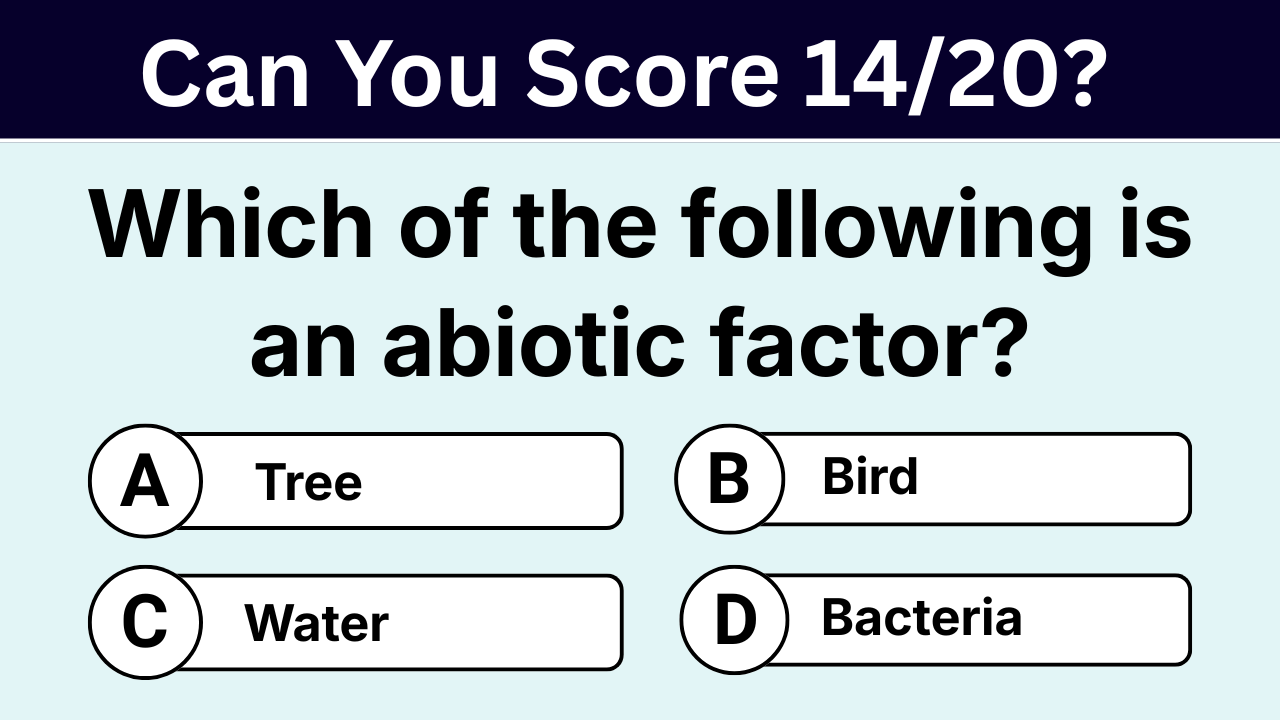
#13. Which of the following is an abiotic factor?
Explanation: Abiotic factors are non-living parts of the environment. Water, sunlight, temperature, and soil are all examples of abiotic factors that affect living organisms.
#14. What happens if all producers disappear from an ecosystem?
Explanation: Producers are the foundation of every ecosystem. Without them, energy cannot enter the food chain. As a result, consumers and decomposers would eventually die due to lack of food.
#15. Which organism can survive without sunlight?
Explanation: Mushrooms are decomposers and do not need sunlight to make food. They get energy by breaking down dead organic matter.
#16. Grass → Deer → Lion represents what?
Explanation: A food chain shows a simple and direct path of energy transfer from one organism to another. In this example, energy moves from grass to deer and then to lion in a straight line.
#17. What role do plants play in the carbon cycle?
Explanation: Plants absorb carbon dioxide from the atmosphere during photosynthesis. This helps regulate the amount of carbon dioxide in the air and supports life on Earth.
#18. Which organism is a secondary consumer?
Explanation: Secondary consumers eat primary consumers. Since snakes often eat animals like rabbits that feed on plants, they are classified as secondary consumers.
#19. Which level comes first in a food chain?
Explanation: Every food chain begins with producers because they are the only organisms that can directly capture energy from the Sun. This energy is then passed on to consumers when they eat plants or other animals.
#20. Which organism makes its own food using sunlight?
Explanation: Producers are organisms like plants and algae that can make their own food through a process called photosynthesis. They use sunlight, water, and carbon dioxide to produce energy-rich food, which becomes the main energy source for all other organisms in the ecosystem.
More – Latest Quizzes For Grade 5-12