Grade 11 Physics Motion Forces Quiz Questions with Answers
This Grade 11 Physics Motion and Forces quiz is prepared by a teacher to help students understand laws of motion, force, inertia, acceleration, and momentum. Includes 20 concept-based questions with clear explanations, ideal for high school exam practice and regular revision.
Get daily quizzes, practice tests, and free learning updates.
Follow on FacebookPhysics Motion & Forces Quiz | 20 Questions with Answers for Grade 11
Results
Excellent work! You have passed this Grade 11 Physics quiz and shown a clear understanding of motion and forces. Keep practicing similar quizzes on Quizmento to improve problem-solving skills and exam confidence.
More Latest Quizzes – Click Here.
Do not feel discouraged. Physics concepts become strong with practice. Review the explanations carefully and try again. Visit Quizmento regularly to master motion and forces step by step.
More Latest Quizzes – Click Here.


#1. What is the SI unit of force?
Explanation: Force is measured in newtons in the SI system. One newton is the force required to accelerate a 1 kg mass by 1 m/s².
#2. Which force always opposes motion?
Explanation: Friction acts in the opposite direction of motion and reduces speed. It occurs due to contact between two surfaces.
#3. Which factor does friction depend on?
Explanation: Friction depends mainly on how rough or smooth the surfaces are. Rough surfaces produce more friction than smooth ones.
#4. What is acceleration?
Explanation: Acceleration occurs when there is a change in speed, direction, or both. Even an object moving at constant speed in a circular path is accelerating due to change in direction.
#5. What does Newton’s Second Law explain?
Explanation: Newton’s Second Law states that acceleration depends on the force applied and the mass of the object. Greater force produces greater acceleration, while greater mass reduces acceleration.
#6. Why is seat belt important in a moving car?
Explanation: During a sudden stop, inertia causes the body to keep moving forward. Seat belts apply a force that slows the body safely and reduces the risk of injury.
#7. What is motion in physics?
Explanation: In physics, motion means that an object changes its position relative to a reference point as time passes. If an object does not change its position with respect to its surroundings, it is considered at rest.
#8. Which quantity is directly related to inertia?
Explanation: Mass is a measure of inertia. An object with greater mass requires more force to change its motion compared to an object with smaller mass.
#9. What does Newton’s Third Law state?
Explanation: Newton’s Third Law explains that forces always occur in pairs. When one object exerts a force on another, the second object exerts an equal force in the opposite direction.
#10. What happens to acceleration if force increases and mass remains constant?
Explanation: According to Newton’s Second Law, acceleration is directly proportional to force when mass is constant.
#11. Why does a passenger move forward when a bus stops suddenly?
Explanation: When the bus stops suddenly, the passenger’s body tends to continue moving forward due to inertia, which resists sudden changes in motion.
#12. What causes a change in the motion of an object?
Explanation: A force can change the speed, direction, or shape of an object. Without force, an object continues in its current state of motion according to Newton’s First Law.
#13. Which force pulls objects toward the Earth?
Explanation: Gravitational force is the attractive force between masses. Earth’s gravity pulls objects toward its center.
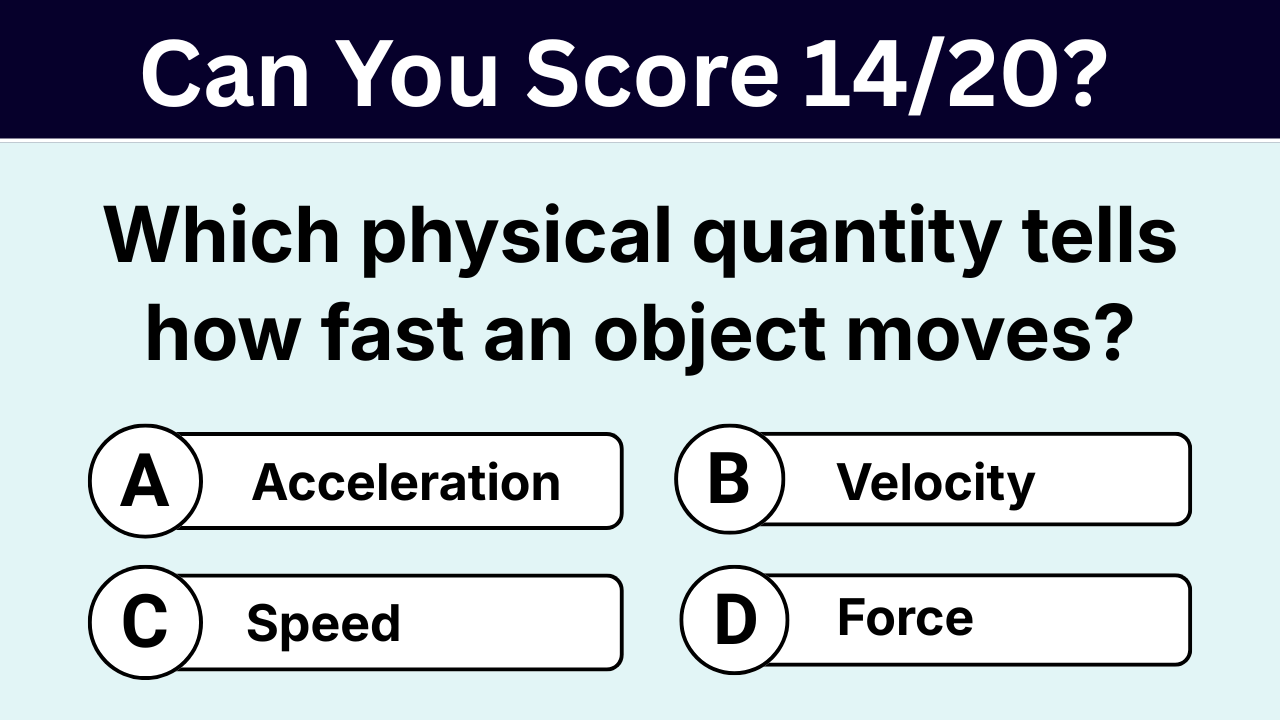
#14. Which physical quantity tells how fast an object moves?
Explanation: Speed measures how fast an object is moving and depends only on distance traveled per unit time. It does not include direction, which makes it a scalar quantity.
#15. What is velocity?
Explanation: Velocity includes both speed and direction. If either the speed or direction of motion changes, the velocity of the object also changes.
#16. What is inertia?
Explanation: Inertia is a property of matter by which an object resists any change in its state of rest or motion. Objects with more mass have greater inertia.
#17. What is momentum?
Explanation: Momentum depends on both mass and velocity. An object with greater mass or higher velocity has greater momentum.
#18. Which situation shows uniform motion?
Explanation: Uniform motion means equal distances are covered in equal intervals of time in the same direction.
#19. What happens when net force on an object is zero?
Explanation: Zero net force means balanced forces. In this case, there is no acceleration, and the object maintains its current state of motion.
#20. Which law explains inertia?
Explanation: Newton’s First Law states that an object remains at rest or in uniform motion unless acted upon by an external force. This tendency to resist change in motion is called inertia.
More – Latest Quizzes for Grade 5-12