Grade 7 GK Quiz Questions & Answers | Free Printable Trivia Questions
This General Knowledge Quiz Questions with Answers for Grade 7 helps USA middle school students master science, geography, and history facts.
20 practice questions with teacher explanations. Parents and teachers can track progress easily. Free printable!
Get daily quizzes, practice tests, and free learning updates.
Join WhatsApp ChannelGK Quiz Questions and Answers for Grade 7 Students
This Grade 7 GK Quiz is designed for US middle school students to practice general knowledge topics taught in 7th grade classrooms.
Each question covers science facts, geography trivia, history highlights, and basic math logic with clear, student-friendly explanations.
Perfect for homework review, classroom warm-ups, or family learning time. 70% score (14/20) to pass!
Results
Well done, student.
You have shown a clear understanding of US government and civic responsibilities.
Keep learning, stay informed, and continue practicing higher-level civics topics.
More Quizzes – Click Here
Do not feel discouraged.
Civics is learned step by step through reading and practice.
Review the explanations carefully and attempt the quiz again with confidence.
More Quizzes – Click Here


#1. What is the hardest natural substance found on Earth?
Explanation: Diamonds are at the top of the Mohs hardness scale, so we use them for tools and jewelry.
#2. What is the process by which water changes into water vapor called?
Explanation: When heat turns liquid water into gas, like clothes drying on a line or puddles vanishing after rain.
#3. Which gas do plants take in from the air during photosynthesis?
Explanation: Plants use sunlight and carbon dioxide to make their own food, giving off oxygen. That’s why trees are Earth’s lungs!
#4. Which country is both a continent and a country?
Explanation: Australia is one huge island continent that’s also a single nation, bordered by the Indian and Pacific Oceans.
#5. What is the largest mammal in the world?
Explanation: Blue whales can reach 100 feet long—they’re ocean dwellers but true mammals with lungs.
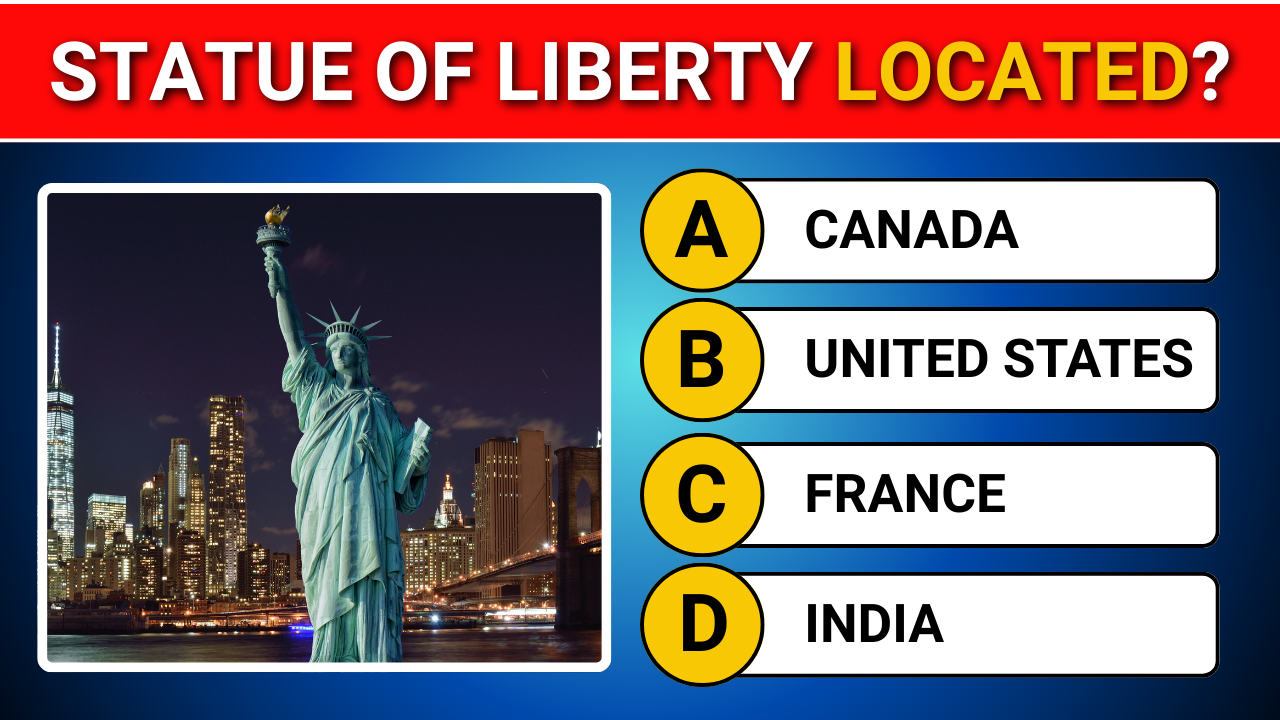
#6. In which country is the Statue of Liberty located?
Explanation: It’s on Liberty Island in New York Harbor—a major symbol of freedom. France gifted it to the USA back in 1886.
#7. Which basic unit is used to measure electric current: ampere, meter, or kilogram?
Explanation: Ampere (or “amp”) measures electrons flowing per second in a circuit. Meter is length, kilogram is weight.
#8. Which instrument is used to measure temperature?
Explanation: Thermometers measure in degrees Fahrenheit or Celsius—from weather stations to your doctor’s office.
#9. Which planet in our solar system is known as the Red Planet?
Explanation: Mars looks red because of iron oxide, or rust, covering its surface. It’s one of the coolest planets we study in science!
#10. Who was the first person to walk on the Moon?
Explanation: In 1969, Neil Armstrong took that “one small step for man, one giant leap for mankind” on Apollo 11.
#11. Which American state is famous as the “Sunshine State”?
Explanation: Florida has over 230 sunny days a year—great for beaches and its official nickname on license plates!
#12. What is the largest ocean on Earth?
Explanation: The Pacific Ocean is the biggest and deepest, separating the Americas from Asia and Australia. “Pacific” actually means peaceful.
#13. In which direction does the Sun appear to rise?
Explanation: Earth spins from west to east, making the Sun seem to rise in the east every day.
#14. Which is the longest river in the world?
Explanation: The Nile flows over 4,100 miles through Africa into the Mediterranean.
#15. Which organ in the human body pumps blood?
Explanation: Your heart is a powerful muscle that pumps oxygen-rich blood to every part of your body.
#16. Which layer of Earth do we live on: crust, mantle, or core?
Explanation: The crust is Earth’s thin, solid outer layer where we live, with continents and oceans on top.
#17. What do we call animals that eat only plants?
Explanation: Cows, deer, and rabbits are herbivores. They play a big role as primary consumers in food chains.
#18. Who wrote the famous play “Romeo and Juliet”?
Explanation: Shakespeare’s timeless tragedy about young love is a must-read in middle school English class.
#19. How many sides does a hexagon have?
Explanation: “Hexa” means six, just like the hexagonal cells in a beehive honeycomb.
#20. How many continents are there on Earth?
Explanation: There are seven continents: Asia, Africa, North America, South America, Antarctica, Europe, and Australia. This is key for understanding world maps.
Get daily quizzes, practice tests, and free learning updates.
Join WhatsApp ChannelMore Quizzes –
| Grade 6 General Knowledge Quiz | Click Here |
| Grade 8 Science Quiz | Click Here |
| Grade 7 Geography Trivia | Click Here |
| All Middle School Quizzes | Click Here |
FAQ Schema –
Q: Is this GK quiz suitable for Grade 7 students in USA schools?
Ans: Yes, covers standard middle school topics in science, geography, and history.
Q: Are answers and explanations included?
Ans: Yes, every question has correct answer with teacher explanation.
Q: What is the passing score?
Ans: 70% (14 out of 20 questions).