Science Quiz with Answers | Grade 12 AP Level Test
Free Grade 12 Science Quiz with answers! 20 AP-level questions: physics, chemistry, biology. Ohm’s Law, DNA polymerase, mass-energy equivalence. 70% PASS for college prep. High school senior review!
Get daily quizzes, practice tests, and free learning updates.
Join WhatsApp ChannelGrade 12 Science Quiz Questions with answers Free
Grade 12 science quiz with detailed answers covering AP physics (Ohm’s Law), chemistry (electronegativity), biology (mitochondria). 20 textbook-style questions for senior year review and college prep!
Results
Exceptional work, Grade 12 senior!
You’ve demonstrated AP-level mastery across physics, chemistry, and biology concepts.
Perfect preparation for college science courses and standardized testing!
More Quizzes – Click Here.
Strong foundation being built.
Grade 12 science requires integrating multiple disciplines — review explanations systematically.
Consistent practice leads to mastery!
More Quizzes – Click Here.


#1. Which pancreatic hormone specifically lowers elevated blood glucose levels after meals?
Explanation: Insulin ↑ GLUT4 transporters → glucose uptake by muscle/adipose tissue.
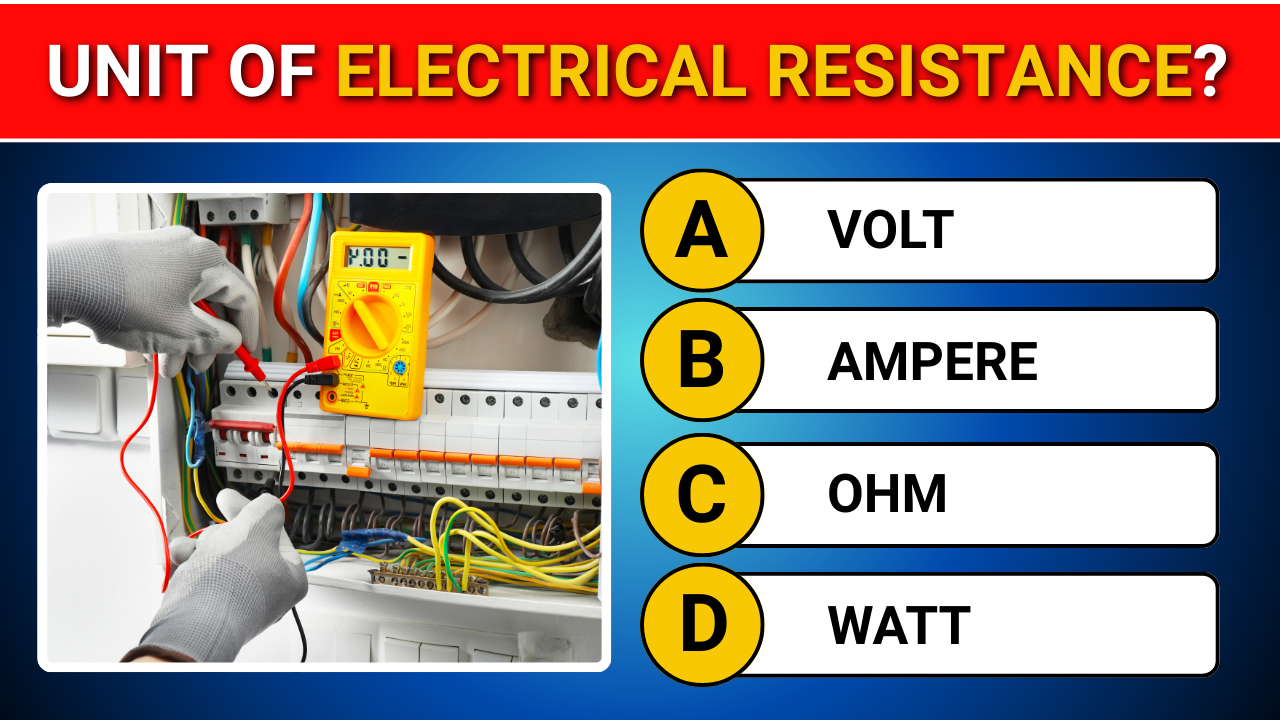
#2. What is the SI unit used to measure electrical resistance in a circuit?
Explanation: Ohm (Ω) quantifies opposition to current flow per Ohm’s Law: V=IR. Essential circuit analysis.
#3. Which factor has the greatest influence on increasing the rate of a typical chemical reaction?
Explanation: 10°C ↑ doubles rate (rule of thumb); activation energy barrier ↓ (Arrhenius).
#4. Which periodic table group contains the most reactive nonmetal elements?
Explanation: Halogens (F, Cl, Br, I) gain 1 electron to complete octet.
#5. In human nephrons, the initial filtration of blood plasma occurs specifically within which structure?
Explanation: Glomerulus hydrostatic pressure forces filtrate through filtration membrane.
#6. Which photosynthetic pigment absorbs light most efficiently at 430nm and 662nm wavelengths?
Explanation: Primary reaction center pigment in photosystems I & II.
#7. Which element exhibits the highest electronegativity value on the Pauling scale?
Explanation: Fluorine (χ = 4.0) strongest electron attractor due to small size, high nuclear charge.
#8. Which enzyme catalyzes the formation of new DNA strands during replication?
Explanation: Adds nucleotides 5’→3′ direction using template strand.
#9. In a step-up transformer, which electrical quantity specifically increases across the secondary coil?
Explanation: Vₛ/Vₚ = Nₛ/Nₚ (turns ratio). Power conserved: P=VI constant.
#10. Which fat-soluble vitamin is primarily synthesized in human skin upon ultraviolet exposure?
Explanation: UVB converts 7-dehydrocholesterol → cholecalciferol (vitamin D₃).
#11. Which nitrogenous base replaces thymine in RNA molecular structure?
Explanation: RNA: A-U, G-C pairing; DNA: A-T, G-C.
#12. The molecular structure of ozone (O₃) demonstrates which specific type of isomerism?
Explanation: Delocalized π electrons across three oxygen atoms; equivalent structures.
#13. Ethanol (C₂H₅OH) and dimethyl ether (CH₃OCH₃) represent which type of constitutional isomerism?
Explanation: -OH (alcohol) vs -O- (ether) different functional groups, same molecular formula.
#14. Newton’s First Law of Motion is also known by which classical name?
Explanation: Objects maintain uniform motion unless acted upon by net force.
#15. What is the standard numerical range of the pH scale used in aqueous solutions?
Explanation: pH = -log[H⁺]; 7=neutral, <7=acidic, >7=basic.
#16. Which cellular organelle serves as the primary site for ATP production through cellular respiration?
Explanation: Inner mitochondrial membrane houses electron transport chain, ATP synthase.
#17. What is the dimensional formula for electrical resistance derived from base SI units?
Explanation: R = V/I = (Work/Charge)/(Charge/Time) = ML²T⁻³A⁻².
#18. What is the approximate acceleration due to gravity experienced on the surface of Earth’s Moon?
Explanation: Moon’s mass = 1/81 Earth’s; radius = 1/4 Earth’s → gₘₒₒₙ = gₑₐᵣₜₕ/6.
#19. Lenz’s Law specifically describes which fundamental physical phenomenon?
Explanation: Induced current creates opposing magnetic field (Faraday’s corollary). Key electromagnetism principle.
#20. How many total chromosomes are present in a typical human diploid somatic cell?
Explanation: 22 homologous autosomal pairs + 1 sex chromosome pair (XX or XY).
More Quizzes –
| US History Practice Test Grade 9 | Click Here |
| Grade 10 Vocabulary Practice | Click Here |