Grade 6 Science Quiz | Middle School 20 Questions with Answers
Free Grade 6 Science Quiz! 20 NGSS questions: mitochondria (powerhouse), Earth density, photosynthesis equation, Boyle’s Law, tectonic divergence. Middle school USA students. 70% PASS!
Grade 6 Science Practice Test Questions and Answers
Grade 6 science quiz for middle school: mitochondria ATP production, Earth highest density planet, photosynthesis 6CO₂+6H₂O, Boyle’s Law P₁V₁=P₂V₂, divergent boundaries. 20 NGSS MCQs!
Get daily quizzes, practice tests, and free learning updates.
Join WhatsApp Channel Follow on Facebook20 Grade 6 science questions aligned with NGSS standards for middle school US students. Life, physical, Earth science. 70% (14/20) to PASS!
Results
Outstanding Grade 6 science mastery!
You’ve conquered NGSS middle school standards across life science, physical science, and Earth systems.
Perfect preparation for state science assessments and STEM competitions!
More Quizzes – Click Here.
Strong science foundation building!
Grade 6 concepts require connecting cell processes, energy forms, and Earth systems.
Review detailed explanations — you’ll ace it next time!
More Quizzes – Click Here.


#1. SI unit measuring electric current flow?
Explanation: 1A = 1 coulomb/second. Circuits: I = V/R (Ohm’s Law).
#2. What is the powerhouse of the cell where ATP energy is produced?
Explanation: Mitochondria convert glucose + oxygen → ATP + CO₂ + H₂O via cellular respiration. Double membrane structure; inner cristae increase surface area for reactions. “Powerhouse” due to energy production essential for all eukaryotic cells.
#3. What causes seasonal changes on Earth?
Explanation: Tilt creates varying sunlight duration/intensity. Tropic of Cancer/Capricorn mark solstices. Perihelion/aphelion minor effect.
#4. What do valence electrons primarily determine?
Explanation: Outer shell electrons form ionic/covalent bonds. Octet rule: 8 electrons = stable (noble gases).
#5. Gas law: pressure up → volume down (constant T)?
Explanation: P₁V₁ = P₂V₂. Syringe compression demo.
#6. Granite/basalt form from magma/lava cooling?
Explanation: Intrusive (slow, crystals), extrusive (fast, fine-grained).
#7. Which Earth layer is liquid iron generating magnetic field?
Explanation: Dynamo effect: convection + rotation creates geodynamo protecting atmosphere from solar wind.
#8. Heat transfer by direct particle contact occurs via?
Explanation: Solids best (metals free electrons). Poor conductors = insulators (wood/plastic).
#9. Oceanic ridges where plates diverge form new crust?
Explanation: Magma rises; Mid-Atlantic Ridge spreading 2.5cm/year.
#10. Which planet has highest average density in solar system?
Explanation: Earth 5.51 g/cm³ from iron-nickel core (32% mass). Rocky planets denser than gas giants.
#11. What recycles dead organisms back to soil nutrients?
Explanation: Break complex organics into inorganic ions via enzymes. Nitrogen cycle key role.
#12. What determines pitch of sound wave?
Explanation: Higher Hz = higher pitch (violin vs tuba). Human range 20Hz-20kHz. Doppler effect changes perceived frequency.
#13. What fundamental force attracts all masses?
Explanation: F = G(m₁m₂)/r² (Newton). Weakest force but infinite range.
#14. What pH range indicates acidic solutions?
Explanation: pH = -log[H⁺ ions]. Lemon juice ~2; vinegar ~3. Litmus paper turns red.
#15. What process converts sunlight, CO₂, water into glucose + oxygen?
Explanation: 6CO₂ + 6H₂O + light → C₆H₁₂O₆ + 6O₂. Chlorophyll in chloroplasts absorbs red/blue light. Plants producers in food webs.
#16. Phospholipid bilayer selectively permeable structure?
Explanation: Fluid mosaic model: proteins embedded for transport/receptors.
#17. Which subatomic particle carries negative charge and orbits the nucleus?
Explanation: Electrons (-1 charge) determine chemical properties via valence shells. Equal number to protons makes atom neutral. Discovered by J.J. Thomson (1897 cathode ray).
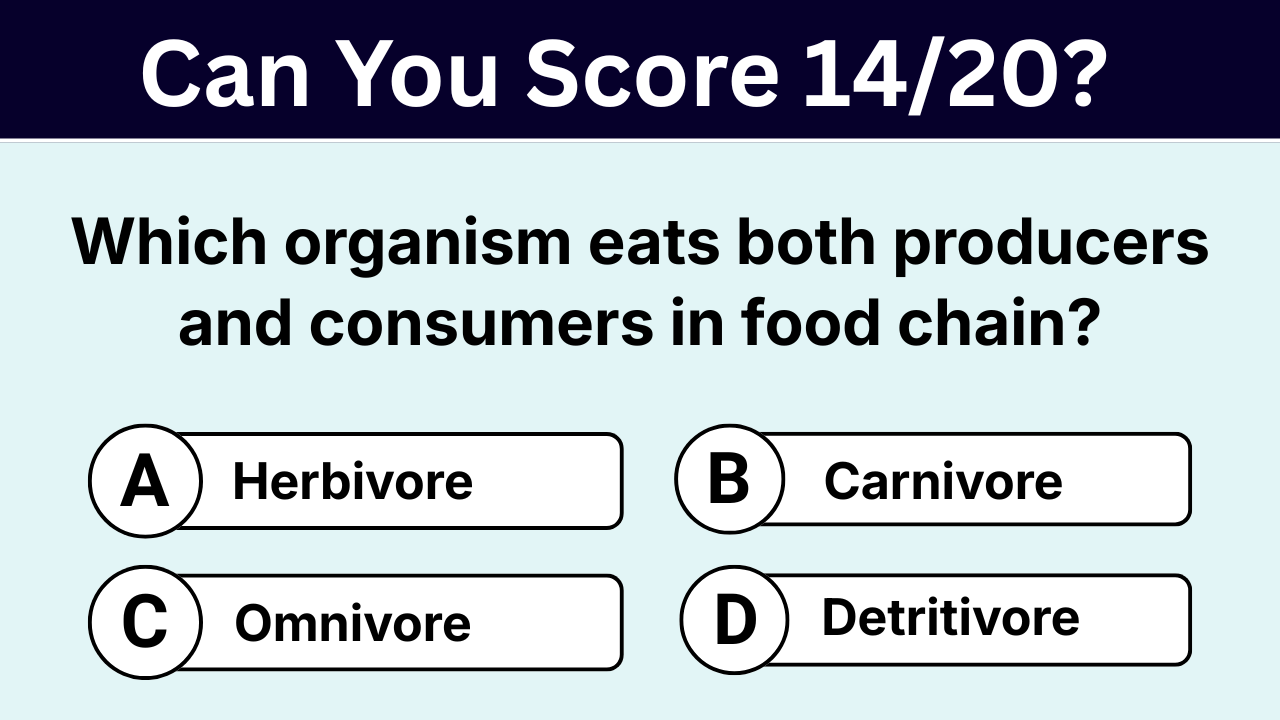
#18. Which organism eats both producers and consumers in food chain?
Explanation: Omnivores (humans, bears) occupy multiple trophic levels, ecologically versatile.
#19. Desert plant adaptation reduces transpiration?
Explanation: Cuticle waterproof barrier; CAM photosynthesis opens stomata night.
#20. What type of energy is stored in a raised object or stretched spring?
Explanation: Potential energy = mgh (gravitational) or ½kx² (elastic). Converts to kinetic when released. Rubber band snap = elastic → kinetic.
More Quizzes –
| Geography Quiz Test Grade 6 | Click Here |
| Science Quiz Test Grade 6 | Click Here |