Science Revision Quiz | Grade 5 Science Practice Test
Free Grade 5 Science Revision Quiz! 20 NGSS questions: matter, photosynthesis, Earth orbit, water states, conductors. Perfect elementary review. 70% PASS score with detailed explanations!
Get daily quizzes, practice tests, and free learning updates.
Join WhatsApp ChannelScience Revision Quiz | Grade 5 NGSS Practice Test
Grade 5 science revision quiz: Earth surface (71% water), matter definition, photosynthesis gas (CO₂), cell nucleus, Sun as energy source. 20 NGSS practice questions with explanations!
20 revision questions for Grade 5 US students. Topics: Earth science, life science, physical science. Score 70% (14/20) to PASS!
Results
Fantastic science skills, Grade 5 student!
You’ve reviewed Earth science, life science, and physical science concepts perfectly.
Great job preparing for science fairs and state assessments!
More Quizzes – Click Here.
Excellent review practice!
Grade 5 science builds through hands-on experiments and concept connections.
Study explanations carefully — you’ll ace your next science test!
More Quizzes – Click Here.


#1. Which organ in the human body helps remove harmful toxins from the blood?
Explanation: The liver filters blood, breaks down harmful substances, and helps with digestion.
#2. Which group of animals usually has moist skin and can live on land and in water?
Explanation: Frogs and salamanders are amphibians and need water for part of their life cycle.
#3. Which of these shows a human impact on the environment?
Explanation: Cutting trees for roads is a human activity that changes habitats and ecosystems.
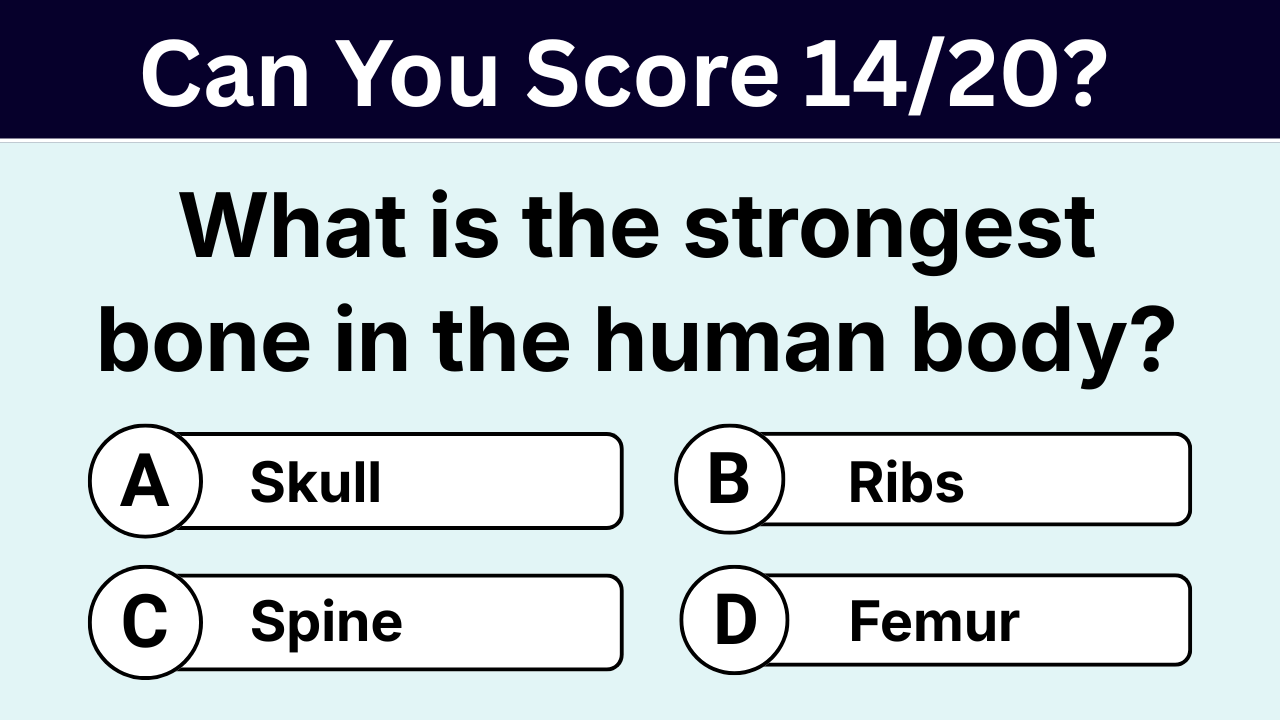
#4. What is the strongest bone in the human body?
Explanation: The femur supports body weight and is the longest, strongest bone.
#5. When Earth spins once around its axis, what do we experience?
Explanation: One full rotation takes about 24 hours, creating day and night.
#6. What is any substance that has mass and takes up space called?
Explanation: Matter is anything with mass and volume, like air, water, and rocks.
#7. What do we call a change from a liquid to a gas at the surface of the liquid?
Explanation: Puddles drying after rain is an example of water evaporating into the air.
#8. Most of Earth’s surface is covered by which substance?
Explanation: About 71% of Earth’s surface is covered by oceans and other water bodies.
#9. Which part of a plant makes most of the food?
Explanation: Leaves contain chlorophyll and perform photosynthesis using sunlight.
#10. What do we call animals that only eat plants?
Explanation: Herbivores, such as cows and rabbits, get energy by eating producers (plants).
#11. Which gas do plants mainly use from the air during photosynthesis?
Explanation: Plants take in carbon dioxide and release oxygen while making food in their leaves.
#12. What do we call the path Earth takes as it moves around the Sun?
Explanation: Earth orbits the Sun once every year (about 365 days).
#13. Which of these materials is a good conductor of electricity?
Explanation: Metals like copper let electric charges move easily, so they are used in wires.
#14. Scientists use which tool to measure how hot or cold something is?
Explanation: Thermometers measure temperature, often in degrees Celsius or Fahrenheit.
#15. At about what temperature in degrees Celsius does water boil at sea level?
Explanation: Water boils at 100°C, which equals 212°F, under normal air pressure.
#16. Which form of heat transfer happens when you feel warmth from the Sun through space?
Explanation: Radiation moves energy as waves and does not need matter to travel.
#17. What is the main source of energy for life on Earth?
Explanation: The Sun provides light and heat, driving photosynthesis and weather patterns.
#18. Which of these is a decomposer in an ecosystem?
Explanation: Decomposers like fungi break down dead plants/animals and return nutrients to the soil.
#19. Which state of matter has a fixed shape and fixed volume?
Explanation: In solids, particles are packed closely and only vibrate, keeping shape and volume.
#20. What is the center of a cell called that controls its activities?
Explanation: The nucleus holds genetic material and acts as the control center of the cell.
More Quizzes –
| Science Quiz Test Grade 6 | Click Here |
| English Grammar Grade 5 | Click Here |
| General Knowledge Grade 7 | Click Here |
| Geography Quiz Grade 8 | Click Here |